Showing posts with label pulsatilla. Show all posts

Wednesday, May 02, 2012

More Spring Flowers; Gardening Sessions in La Ronge

Indoor plant starting is running in high gear at the moment.  Vegetables, annual flowers, and a few perennials are starting to grow in pots under fluorescent lights.  I like growing my plants in re-usable plastic pots in trays lined with felt-like wicking fabric (I bought mine at Lee Valley Tools).  I water the plants by pouring water in the front of the tray and the fabric wicks it up to the bottom of all the pots.  I have a fan keeping the air circulating in the room, reducing problems with fungus. 
Light garden in full production.

Bunny sitting among the Primula auricula.

Unknown variety of Draba in flower.  This plant is three years old but still would fit within the palm of my hand. 

The hairy flowers of Pulsatilla vulgaris (left) are adding to the color of the crocuses.

Tiny yellow Iris danfordiae is said to be a zone 5-9 plant, but it made it through our recent mild winter just fine.

Ruffed grouse on the compost pile.

Kona out for a walk in the forest.  Snow remains in shady areas.
I was unaware of the habits of the grouse, wondering for days what the repeated drum rolls in the backyard were all about.  It didn't seem to be of human origin, yet it seemed too loud for an animal.  I could hear the drumming at night, from my bedroom.  Finally, dear resident-lawnmower-man told me that it was the sound of the grouse.  I did finally see the bird flapping his wings in his eager efforts to attract a mate.  His choice of location just meters from the fence containing our grouse-eating dog was interesting, however. 

If you are a local person interested in gardening, we are lucky to have "Gardening Wednesdays" sessions at 7 pm in La Ronge. 
  • May 9 is Planting Seeds and Propagation at Churchill Community High School, 
  • May 16 is Flowers in the North at Churchill Community High School
  • May 23 is Creating and Gardening in Raised Beds at 1312 Houghton Place, and 
  • May 30 is Container Gardening at 1331 Kowalski Place.  
I'll won't be able to attend, but am excited that local gardeners are out spreading the word about growing plants here in northern Saskatchewan. 

Friday, May 20, 2011

Garlic Grows Here!

We just got back from our visit to the southern parts of the province. I could detect our northward travel with my eyes closed: the splatting noise of insects hitting the windshield got both more frequent and louder. The windshield was covered in yellow and brown goo by the time we got back to La Ronge. Ahhhh, welcome to summer, northern residents!
Large raised perennial bed:

Alpine garden, with white flowers of Cerastium alpinum (foreground) and Erigeron compositus:


In another hardiness experiment, I planted hardneck garlic in the vegetable raised bed last fall. This was new to me, and I wasn't entirely sure how to do it, but I must have done something right. There are two garlic plants sticking boldly out of the soil, which is so exciting! It is a variety called "Music". I can't even recall why I picked this type of garlic, if indeed there was a reason. I received a few whole garlic bulbs and broke these into single cloves, careful to leave a bit of the base plate attached to each clove. I planted them in my vegetable raised bed, which is some soil contained by a rectangle of 10" high lumber.
White Pulsatilla vulgaris growing in part shade:

I am also quite pleased that most of my strawberries overwintered well. They were planted in the vegetable raised bed and covered with a bit of leaf mulch for the winter. They only came up and showed some leaves this week, reassuring me that they are still here. Previously, I had only been aware of the everbearing and June-bearing strawberries. The new day-neutral types were recommended by several sources, including the University of Saskatchewan gardenline. I'm hoping for a great crop this year.
Strawberry "Hecker", purchased last year at Dutch Growers in Saskatoon:

Wednesday, April 27, 2011

First Flowers and the Veggies Installed

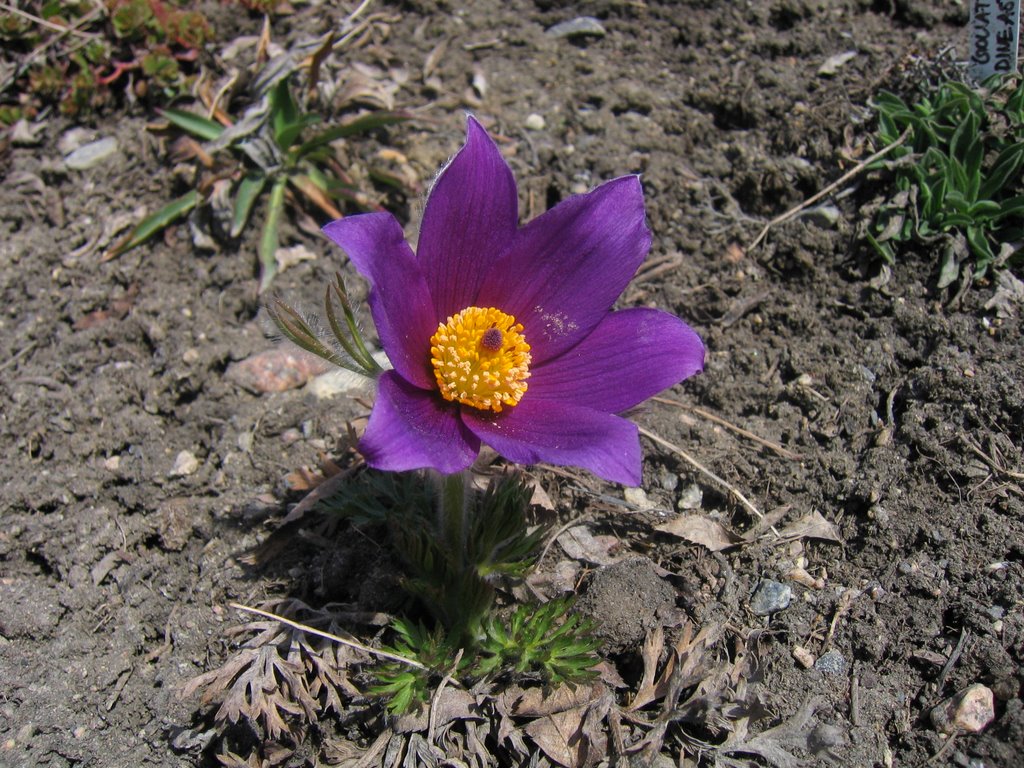
My official first flowers of 2011 are those of Pulsatilla vulgaris, which is not the usual first flower, but welcome nonetheless. These flowers started showing colors on Easter weekend, but waited for today's calm sunny weather to really open up. They are traditionally known for being an Easter-blooming flower, and are very hardy. They get larger and and have more flowers every year, making a spectacular show as a mature plant.
Pulsatilla vulgaris in the sloped rock garden:

They also can be easily propagated. I make sure that several seed heads get spread around the flower bed in late summer, producing new plants all over this flower bed. I also have deep red and white versions of this same perennial flower, though they aren't blooming yet.

We got the vegetable garden seeded today, with the warm dry weather drawing us outside. It felt great to spread the crumbly composted cow manure as a top-dressing in the raised bed for the vegetables. Hopefully the vegetables reward this effort. This is probably the earliest we have planted the vegetable garden, but only cooler-weather veggies went in today, with the beans waiting till later (and tomatoes/pumpkins/zucchini growing indoors). The junior gardener #1 helped put in swiss chard and beets, then left to lounge in the shade and adjust her accessories while the lettuce, carrots, dill, pak choi, snow peas, and spinach were sown. The cute cartoon characters on a packet of giant sunflowers appealed to junior gardener, so a separate weedy patch was cleared for those. I can't wait till she sees those plants grow bigger than her! Go vegetables!


Saturday, June 13, 2009

Starting Tulip Season in the North

Yes, it is June 13 and tulip season has begun! Wow, better late than never. Resident- lawnmower-man spent a great deal of time mowing the large lawn this afternoon, so I can take pictures again without fearing the unsightly grass. Of course, if he would just let me replace the lawn with a mass of shrubs, perennials, trees, and a fortune in bark mulch, we'd not have this problem of mowing. Alas, that will never happen, says he.
Lily-flowered "Claudia" tulip, planted fall 2008:

Tulips: at the back is purple Triumph tulip "Negrita" (planted 2007), yellow and white "Calgary Flame" and in the foreground, "Blue Diamond" Double Late (planted 2007 and also smaller this year).

This next picture demonstrates why you cannot grow fancy modern tulips year after year without replacing them. This purple and white "Zurel" Triumph tulip was planted in 2007 and this year only one of the plants has produced a flower (which is puny and unimpressive).

The rest of the Triumph tulips that are 2+ years old are also showing miniaturized flowers. I'll be digging these up and replacing them with new bulbs this fall. Generally, I would say that the Single Late tulips seem to last a few years longer than the Triumph tulips.
Two colors of Pulsatilla vulgaris in the sloped rock garden:

Yet another experiment on zone-stretching: Anemone blanda "Blue Star" made it through the winter! I planted this bulb last fall in the center raised bed. It is labelled as zone 4 or 5 on plant websites, though it seems to be hardy here.

Saturday, May 17, 2008

Spring Bulbs and Colorful Pasque Flowers

The weather has been warm for the last few days, coaxing the spring blooms open (finally). I have more blooms to admire today, and I notice that the daffodils may bloom soon as well! I will be disappointed if there are no big blooms in my yard when we have visitors a week from now.
Purple Pulsatilla vulgaris:

Here are three shades of pasque flowers (Pulsatilla vulgaris) in my yard. These plants form nice-sized plants in about three years. The flowers make a big show before much foliage has grown. I'd like to grow some more of the dark pink/red ones, but you have to plant the seed fairly quickly after maturity because the seed is "ephemeral", as seed sellers put it (it doesn't last long). I should try using my own fresh seeds. I'd also like to add a yellow one to my collection some day.

I just planted the new white-flowered Pulsatilla last fall.

Grape hyacinths have just started to bloom in the last two days:

Tulipa turkestanica, another botanical tulip. These started to bloom today.

Pulmonaria saccharata "Mrs. Moon" does well under the partial shade of tree branches. It has delicate blue and pink flowers in spring. This one must have self-seeded, because I found about 6 little plants around the large one. I read that other growers complain of powdery mildew with this plant, but I haven't had those problems here.

Pulmonaria blooms:

Thursday, July 12, 2007

Pink, White, and Blue in the Garden

Today's blooming of my Pulsatilla vulgaris "dissecta" was a suprise. Not just because this is a little late for Pasque flowers, but because it certainly isn't a "dissecta". I ordered two of this plant and obviously, this plant was mislabeled or the seed didn't come true. Anyhow, does anyone have a name for this lovely pink Pulsatilla? Otherwise, I now have white, two shades of purple, and red ones. This one is distinct from all the others and the company I bought it from doesn't even sell pink ones!
Mystery Pink Pulsatilla
I dug all the rest of the Siberian irises out of the bank of sedum this spring, thinking they'd get more water in the raised beds. Somehow I missed this one, a "Snow Queen" Siberian iris. It seems to be doing fine though. Ironically, most of the irises planted in the raised beds in fall 2005 have not bloomed!

I let my group of cornflowers spread seed last year and now I have this pretty blue haze of annual cornflowers (Centaurea cyanus) among the perennials. I notice that several little birds are starting the enjoy my forest of flowers too, because there is always some fluttering and rustling among the plants when I go out to the big raised bed. Come to think of it, that's probably why I also saw a cat slinking around there last night...
An update to the rest of you southern gardeners -- I am still waiting for my first daylilies! They have buds though, and I promise to send pictures. Karen in Ontario has the most amazing collection of daylilies - seventy of them! I'd definitely have to dig up the lawn to make room for that many daylilies...

Wednesday, May 09, 2007

Shades of Pasque Flowers

While today is dark and stormy (okay, so it's a downright snowstorm), I am reflecting on yesterday's pictures of the lovely pulsatillas. It's Latin name is Pulsatilla vulgaris, also called Anemone pulsatilla, Pasque flower, or prairie crocus (although they're NOT crocuses). The purple ones grow wild in Saskatchewan. Their delicate finely cut foliage, fuzzy flower buds, rich flower colors, and feathery seed heads are all beautiful. I grow mine on a bank in full sun in rather poor soil. They would probably be bigger if the soil was more rich. Pulsatilla are quite drought tolerant when established. I have three different colors of these flowers, most of which I grew from seed:


Red Pulsatilla vulgaris

Dark Purple Pulsatilla vulgaris

Light purple Pulsatilla vulgaris

Of course, my collection is missing the white one and maybe there are others I don't know about. I really want to propagate more of the red one so that I wil have nice big clumps of it blooming in the spring. They are showy and quite visible from a distance. Their seed is "ephemeral" as the seed companies call it, expiring not long after ripe, so I'll plant the fresh seeds as soon as possible. Maybe I'll have a bunch of plants for fall planting. They may require cold stratification to germinate, so maybe we'll have seeds planted in the fridge again.
I've only ever purchased these seeds from Gardens North, a seed company with lots of native plant seeds. I get all tingly and starry-eyed just looking at their online catalogs...and I see they're having a 50% off sale all this month. No, they don't pay me to advertise, I just order their stuff frequently! I notice they don't have any pulsatilla at the moment though.

Thursday, April 27, 2006

Pulsatilla Vulgaris


This pasque flower, or Pulsatilla vulgaris was started from seed in 2005 (from Gardens North). This photo taken April 18 and shows the first flower produced. Clearly, it is a very hardy, showy, and early-blooming perennial. Next year it will probably have multiple blooms. Its common name of pasque means "of Easter" because of its bloom time near Easter. Even in our climate, it was right on target!