

Hello to anyone who might stumble across this message! Now that I have got plants in the ground in our new location in British Columbia, and spring is in sight, I have started a new blog (still on Blogger). I am documenting my adventures with dry-land native plants and a range of water-wise perennials, while living in an apple orchard in Summerland. I also have put up a page about my use of LED grow lights, as I am finding retailers and information hard to find. Find me at my new blog, Apples and Asclepias.
Subscribe To

 Posts
All Comments
Posts
All Comments
Sunday, February 22, 2015


Tuesday, June 03, 2014
Relocated and Got My Hands Dirty!
Well, I most excitedly announce that gardening has recommenced 1150 km to the southwest. Yes, we are in beautiful British Columbia and the gardening season is hotter, longer, and drier here. We are in Summerland, to be specific, and have carved out a nice spot of orchard land to live on amid some apple trees. The disturbed soil on the property needs to be tamed and planted, and we are discovering the local flora and fauna, including the SNAKES. At least we haven't come across the poisonous snakes...yet.
I spent some time today removing yards of Virginia creeper from the canopy of a long-neglected plum tree that we noticed growing in our yard. I am not sure if it was even intended to be living in its current location or just arrived by accident of nature, but we certainly can appreciate it. Perhaps we can devise some way to water it on occasion, though plum and apricot trees seem pretty adapted to the climate here.
I think I will probably start blogging on a new blog (now that I am not so northern) and will start exploring the available blogging platforms. After all, I don't want to confuse any northern residents when grapes and figs start to be grown here...not to tempt all you northern folks!
 |
| Phlox longifolia growing wild across the street |
 |
| Prickly Pear cactus, blooming at the Summerland Ornamental Gardens |
 |
| Neglected plum tree, rediscovered |
 |
| Okanagan Lake, looking south towards Penticton |
I think I will probably start blogging on a new blog (now that I am not so northern) and will start exploring the available blogging platforms. After all, I don't want to confuse any northern residents when grapes and figs start to be grown here...not to tempt all you northern folks!
Thursday, September 05, 2013
Wrapping up the Garden
The garden is changing its wardrobe to the fall colors as we enjoy the last days of warm weather. I think today is actually THE last day, according to the weather report. I felt it was probably safe to pack away the summer clothes inside as well, to make room for the warmer items.
 The ever-present screeching squirrel seems to have done a number on the flower bed closest to the house. There appears to be an arm-sized tunnel dug under the bean plant. I guess screaming at us from under the stairs at our front door wasn't good enough.
I have faithfully dead-headed the perennials, hoping to squeeze a few late blooms out of the delphiniums (or at least reduce the volunteer seedlings). Other than the squirrel, we have had few pests this year, including insects. The bunny, while thankfully eating the dandelions, did however much away at the peas and beans in the vegetable garden. Oh well, we still had some to eat for ourselves. I can put up with that.

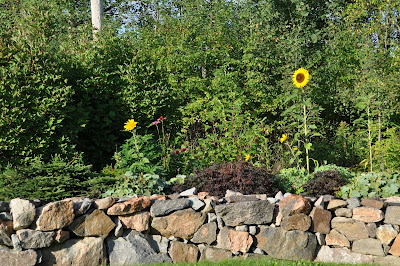 Among the perennials in the large raised bed, I randomly planted a variety of sunflower seeds this spring. The ones on the sunniest end are now blooming and I hope to see a few more. I planted pollen-free sunflowers, which are probably desired by people who want them as mess-free cutflowers, but I mostly just want them to look good outside. I love the combination of the coneflowers (Echinacea) with the sunflowers. They bloom at the same time and the deep pink looks great against the golden sunflowers. The garden-Pinterest of my brain is going to lock this in as an idea to replicate in the future, with even more sunflowers and more Echinacea. The cosmos would also look great in front of the tall sunflowers.
 I pulled out all the Papaver rhoeas, the bright pink annual poppies growing in the center raised bed. They were going brown and had already spread their seed. With them removed, we can now see the few self-seeded cosmos that were fighting their away up amid the poppies. Cosmos are a wonderful late season annual. They are also as easy as throwing a few seeds in the dirt in spring. If you have a small flower bed, the short ones would look best.
The perennials have limited activity at the moment. I see a few blooms starting on the Morden mum and Aster dumosus, but these are pretty small or overgrown with other plants (over-exuberant spirea), so their contribution is mostly invisible!
Otherwise, I have been organizing and cleaning up the gardening tools and supplies. Not just for the winter, but because we are soon moving on from our yard and home. I have had fun with all the plants that thrived or failed here, learning a lot about them. I have ideas on new things I would like to try (branching out into red or orange flowers, which have excluded from this yard) and dreaming about the garden challenges we will meet in our eventual new property, which is in hardiness zone 6 of southern British Columbia! I'm imagining a focus on xeriscaping will be the new challenge, while we enjoy an orchard and perhaps some grapevines. I have enjoyed all the feedback on this garden and will continue on gardening with enthusiasm, though I am really looking forward to throwing out the insect repellent as a necessary gardening tool.
 The ever-present screeching squirrel seems to have done a number on the flower bed closest to the house. There appears to be an arm-sized tunnel dug under the bean plant. I guess screaming at us from under the stairs at our front door wasn't good enough.
  |
| Driveway perennial bed. The Hansa rose is reblooming! |

 Among the perennials in the large raised bed, I randomly planted a variety of sunflower seeds this spring. The ones on the sunniest end are now blooming and I hope to see a few more. I planted pollen-free sunflowers, which are probably desired by people who want them as mess-free cutflowers, but I mostly just want them to look good outside. I love the combination of the coneflowers (Echinacea) with the sunflowers. They bloom at the same time and the deep pink looks great against the golden sunflowers. The garden-Pinterest of my brain is going to lock this in as an idea to replicate in the future, with even more sunflowers and more Echinacea. The cosmos would also look great in front of the tall sunflowers.
  |
| Geese honking over our yard, heading south for the winter. |

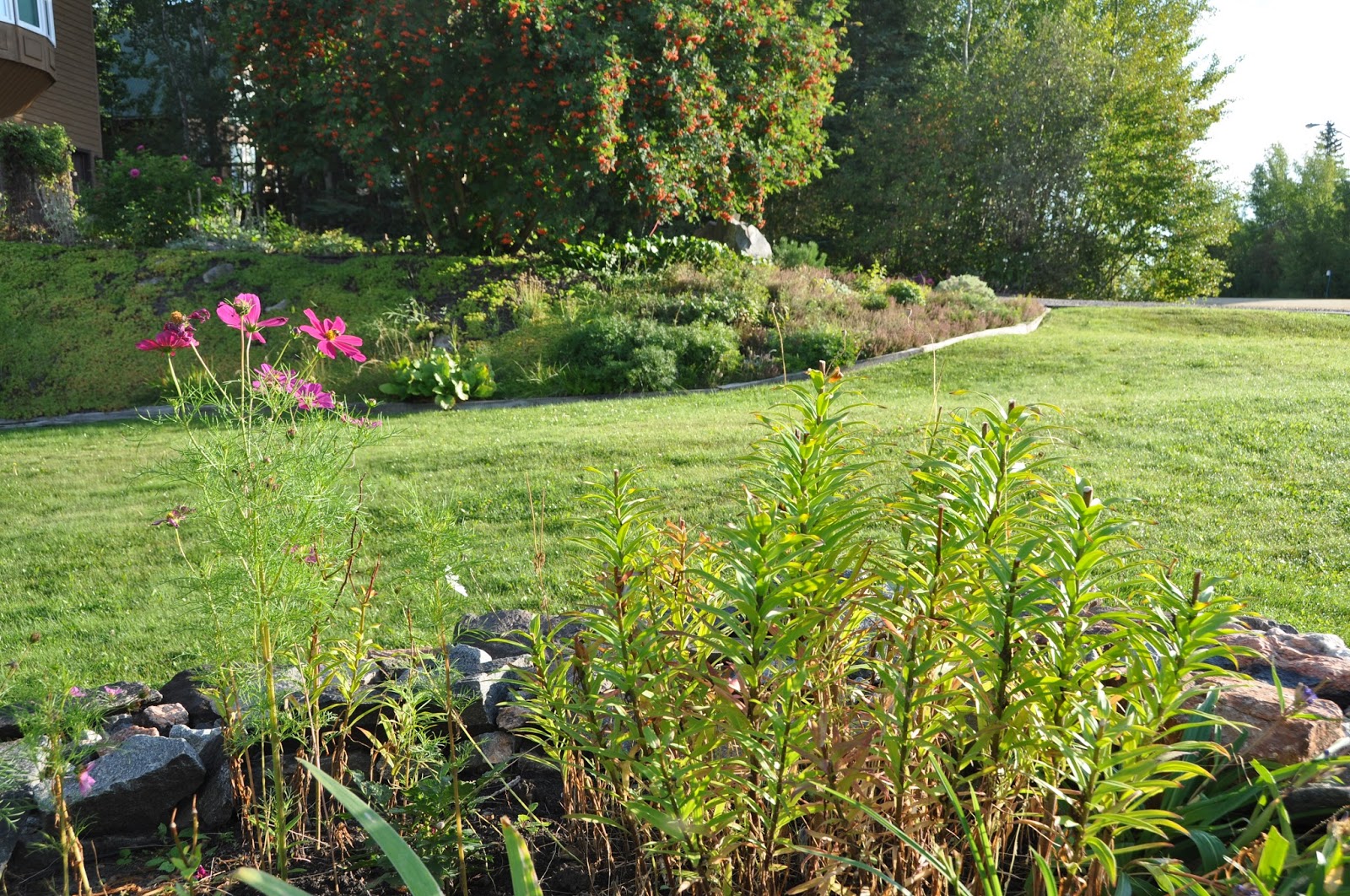 |
| Pink cosmos with the lilies in the center raised bed. |
 |
| Foreground: alpine bed. Background: The large raised bed filled with perennials. |
Subscribe to:
Posts (Atom)