Showing posts with label petunias. Show all posts

Sunday, July 15, 2007

Let's Talk Annuals

For a change of pace, here are some of the annuals I am growing this year!
Barrel planters: I started my "Aladdin Cherry"petunias, "Profusion cherry"zinnias, "Serena"Angelonia (purple and white), and "Violet Queen" cleome from seed for these barrel planters. The Angelonia seed are a novel item, as you could only purchase vegetatively propagated plants until now.
Here are more "Aladdin Cherry" petunias, some ten week stocks (Matthiola incana) - very fragrant, Salvia splendens "Salsa Light Purple", "Serena Purple" Angelonia, and some ornamental sweet potato vines (the vines are the only thing I didn't grow from seed). As you can see, I chose really bright snappy colors, ones that scream "Look at me! Enjoy me! I won't be around forever!"
Pots on my front deck

However, I want to buy some new dark brown pots to match the trim of the house. Hopefully, we'll get to civilization before Wally*mart sells out.

Some sources say this miniature black-eyed susan is an annual and others say it is a perennial. Regardless, it is kinda cute.

A lonely Ruckbeckia hirta "Toto"
Here's my canna "Stuttgart" surrounded by annual flowers. I grew this one in my bedroom all winter and put it out this spring. It really is a bit silly trying to grow one of these big-leafed tropical beauties here, but I'm doing it anyways. Actually, it doesn't look half bad for all that tropical appeal it gives my "subarctic" yard.

Canna "Stuttgart" and annual flowers

Speaking of the tropics, here is Musa acuminata "Dwarf cavendish", a banana plant. The main difference between this one and my indoor ones is the wind-torn leaves on the outdoor plant, which makes it look more like an authentic banana. For a good time, I could pot up a dozen of these on my upstairs deck, sit out there sipping lemonade and think about the only thing that makes this better than a tropical country: the mosquites don't carry malaria. (That's the only thing positive I can say about the mosquitoes). I'll bring the banana back inside in September

Musa acuminata "Dwarf cavendish" (Banana)
Volunteer (annual) blue cornflowers (Centaurea cyanus) and a blue Siberian iris in the perennial bed.

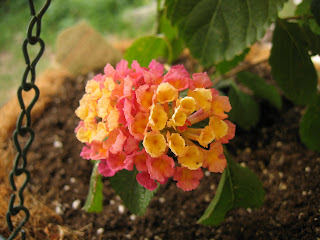
This is a new annual for me: Lantana. It does well in hot, dry conditions in poor soils. Immediately I thought of it for my hanging baskets! It flowers all summer and would be perennial if I lived in Florida. This one is "Bandana pink". Flowers initially are yellow and age to pink.

Lantana Bandana series Pink

Sunday, May 06, 2007

Hot Pink Petunias and the Lettuce Finale

My basement flowers are starting to bloom, pushing the lettuce and herbs out of the way. The Aladdin Cherry petunias and Profusion Cherry zinnias look lovely. They're both a bright pink, sure to make a garish display in the barrel planters.

For those of you following the vermicomposting lettuce saga...we have reached the end of the experiment. For the last post, on day 23, see this previous entry. The romaine lettuce grown in the pot of worm casting compost is the picture of agricultural success, while the potting soil + fertilizer lettuce ended up pathetically small.

An unforeseen lettuce-challenging hurdle in this 60 day trial was my 2-week absence, during which time resident-lawnmower-man tended (that choice of verb may even be too generous) my plants. Despite my warnings about adequately watering the lettuce, I came back to a batch of tough and bitter lettuce, all except for the "worm" lettuce. Yes, the taste test today confirms that the worm lettuce is sweet and mild while the potting soil lettuce is not. Maybe the worm compost had better moisture-retentive properties, protecting it from stingy watering by a non-plantsperson. Moisture retention reportedly is one of the benefits of adding compost to your soil.

Monday, April 30, 2007

Green Things from the Basement

The basement light garden is growing well. The annuals, perennials, orchids and other stuff are aphid and gnat-free so far. The only problem was some mildew that developed while I was away and resident-lawnmower-man was watering the plants. I resolved this by removing the yellowed, withered leaves and directing an oscillating fan to blow over the plants. This restores good airflow, but means I've got to stay vigilant to prevent overdrying of the little plants.

I am currently soaking some morning glory seeds ("Star of Yelta"). The package picture looks attractive, yet up until now I had felt too lazy to do the required chipping of the seed coat and soaking of the seed required for successful germination. Just like lupines and sweet peas, they have a tough seed coat and need some help to germinate. I use an exacto knife to chip off a little piece of the seed coat, leaving a bare spot that shows the green core the the seed. We'll see how it goes!

This flat of Aladdin Cherry petunias looks quite good. Although the seeds and seedlings of petunias are extremely small, growing them seems to be quite easy!

I have just 3 grape tomato plants started, but they quickly grew too tall for the basement light garden so they are sitting with the orchids in the living room. I started my seeds around March 1, so hopefully I can get some mid-summer fruits.

I find it intriguing that the species name for the tomato (Lycopersicon) means "wolf peach". Lykos is Greek for wolf, Lupinum is Latin for wolflike. The wolfish origins of the name don't seem too apparent to me. Some googling revealed the sordid history of the vegetable hailing from South America. It was thought to be poisonous by the Europeans, though the Aztecs had been eating tomato salsa on their chalupas and gorditas for thousands of years (or at least, the Aztecs that went to Taco Bell). Tomatoes are a member of the nightshade family, along with eggplants and peppers, but only the green parts of the plant contain the toxic alkaloids.

According to the climactic data for La Ronge on the northscaping website (http://www.northscaping.com/Tools/ClimaticDataMap.shtml), we have annual precipitation of 19 in. (489 mm), last spring frost May 17, first fall frost Sept 22, for a typical growing season of 128 days. Check out the northscaping website, it has climactic data for North America north of 37 degrees latitude. Anyhow, most tomatoes seem to take much longer than 128 days to do anything, so hopefully this year we have success.