

Hello to anyone who might stumble across this message! Now that I have got plants in the ground in our new location in British Columbia, and spring is in sight, I have started a new blog (still on Blogger). I am documenting my adventures with dry-land native plants and a range of water-wise perennials, while living in an apple orchard in Summerland. I also have put up a page about my use of LED grow lights, as I am finding retailers and information hard to find. Find me at my new blog, Apples and Asclepias.
Subscribe To

 Posts
All Comments
Posts
All Comments
Showing posts with label gardening. Show all posts
Showing posts with label gardening. Show all posts
Sunday, February 22, 2015


Tuesday, August 18, 2009
Google Garden Tours
Here is an interesting use of technology: Google has a tricycle mounted with its all-seeing cameras, designed to record pedestrian-accessible areas for Google street view. The tricycle camera recorded images in the gardens of France's Chateau de Versailles last week and the images are to be posted by the end of the year. I noticed that people's faces and license plates are blurred out. Canada demanded the same before agreeing to allow Google's cameras into Canadian cities. No Canadian cities have had any street view pictures posted yet, but I hope they do soon. Saskatoon was unfortunately filmed in the early spring, when the city was covered in mud and slush and looking generally filthy.
I cruised around the Eiffel tower (on Google street view) this afternoon and noticed streets lined with trees covered in purple blooms. I assume Paris must have been photographed in springtime. This made me think about touring gardens with Google street view. Even if I don't get to all the great gardens of the world in my lifetime, I can take a peek at them them on the computer. At least I'm not burning plane fuel to get anywhere. Oh yes, and it's free.
View Larger Map
I cruised around the Eiffel tower (on Google street view) this afternoon and noticed streets lined with trees covered in purple blooms. I assume Paris must have been photographed in springtime. This made me think about touring gardens with Google street view. Even if I don't get to all the great gardens of the world in my lifetime, I can take a peek at them them on the computer. At least I'm not burning plane fuel to get anywhere. Oh yes, and it's free.
View Larger Map
Thursday, August 02, 2007
Where are the Labrador Gardeners?

I was fascinated to read a letter from a woman in Labrador City, Newfoundland in my monthly issue of "Canadian Gardening". She gardens in a zone 0b climate (yes, "ZERO b"). They have an extremely short growing season and she complains about being at the mercy of the local Wal*mart for plants. She states that "gardening is one of this community's fastest-growing hobbies" and requests that the magazine include a transCanada correspondant for their particular challenges. [The magazine has a regular columns from garden writers in four areas: Ontario, Prairies, British Columbia, Atlantic.] Well, Ms. Simmons from Labrador City, you are a garden superhero! What the world needs is more northern gardening advocacy!
I am now fascinated with this little mining town near the border with Quebec. They even have a Community Beautification and Enhancement Committee and the town has a simple website to instruct community members on lawn care, suitable trees and shrubs and greenhouse growing. They didn't include any list of hardy perennials for their area, which I would have been really interested to see. Community gardens and composting are encouraged by the province of Newfoundland, which would also be a really smart move in Saskatchewan's northern towns. For goodness sakes, gardening would provide some useful physical activity and healthy food to combat the diabetes and obesity that is devastating the local aboriginal population. Maybe the local deepfried chicken joint could sponsor a nice new greenhouse (it would be non-smoking, of course)!
Hurrah to the Newfoundland and Labrador gardeners! May your gardens flourish atop the permafrost.
I am now fascinated with this little mining town near the border with Quebec. They even have a Community Beautification and Enhancement Committee and the town has a simple website to instruct community members on lawn care, suitable trees and shrubs and greenhouse growing. They didn't include any list of hardy perennials for their area, which I would have been really interested to see. Community gardens and composting are encouraged by the province of Newfoundland, which would also be a really smart move in Saskatchewan's northern towns. For goodness sakes, gardening would provide some useful physical activity and healthy food to combat the diabetes and obesity that is devastating the local aboriginal population. Maybe the local deepfried chicken joint could sponsor a nice new greenhouse (it would be non-smoking, of course)!
Hurrah to the Newfoundland and Labrador gardeners! May your gardens flourish atop the permafrost.
Thursday, July 05, 2007
A Gardener's Whims
 I spent a fair bit of time standing in front of this raised bed today, trying to decide what was wrong with it and what I should do about it.
Now, resident-lawnmower-man can't see anything wrong with it, but then again, he will ask me if his pants and shirt match.
The problem is two-fold:
(a) The Campanula persicifolia grew 4 feet tall and looks like isolated towers among its shorter perennial companions in the middle of the bed. The ones snuggling up to the Pacific giant delphiniums look more appropriate.
Then there is a greater problem: (b) Color clash. The Aruncus dioicus (Goatsbeard) and Filipendula vulgaris flowers are cream-colored and the campanula and columbines are pure white. Oh, the crisis of garden color palettes! I think that I prefer the creams, but I am attempting to separate the two while moving tall plants towards the back of the bed.
 Here you can see my unnamed rose bush, which appears to be the same type of rose the neighbours have in their yard -- obviously some very hardy type with purplish-pink flowers. In the foreground is the stalwart fuzzy-headed Artemisia l. "Silvermound". I added the cedar bark mulch recently because I can't plant in that area, having to leave space for the Artemisia.
 I have a nice group of Digitalis grandiflora now. I think that these yellow flowers are the hardiest of the foxgloves, though not necessarily the showiest.
 This is my "shade bed". It is also a catch-all for all the plants whose flowers clash with the pinks and purples in the rest of the yard. Yes, it's a red-flower seclusion area.
Wednesday, June 27, 2007
Pink Potentilla and Columbines
The columbines are blooming now and I'm braving the blowing fluff from the cottonwood trees to take photograph them. Sneeze, sneeze, sniff...

 I started several of these Potentilla x "Helen Jane" two years ago. They have an intense raspberry-pink flower. In good soil and full sun, the largest plant has gotten about 90 cm wide by 50 cm tall. It is not a compact plant, being rather open, but not quite "sprawling".
 This is the neighbour's dock across the street. I'm assuming the grandkid's bicycles are destined for a splash in Lac La Ronge.
  Here are the three sandcherries we planted two years ago. My grand plan is to facilitate cross-pollination between all the cherry trees/shrubs in the yard: Nanking cherry (Prunus tomentosa), Pincherry (Prunus pensylvanica) , "Carmine Jewel" dwarf sour cherry and sandcherry (Prunus x cistena).
  The dwarf sour cherry apparently can self-pollinate, but I understand that the other trees all have better yields when cross-pollinated. I'm not sure if the Nanking cherries are going to make it this year though, as they haven't leafed out yet! Good grief!
I started several of these Potentilla x "Helen Jane" two years ago. They have an intense raspberry-pink flower. In good soil and full sun, the largest plant has gotten about 90 cm wide by 50 cm tall. It is not a compact plant, being rather open, but not quite "sprawling".This is the neighbour's dock across the street. I'm assuming the grandkid's bicycles are destined for a splash in Lac La Ronge. Here are the three sandcherries we planted two years ago. My grand plan is to facilitate cross-pollination between all the cherry trees/shrubs in the yard: Nanking cherry (Prunus tomentosa), Pincherry (Prunus pensylvanica) , "Carmine Jewel" dwarf sour cherry and sandcherry (Prunus x cistena). The dwarf sour cherry apparently can self-pollinate, but I understand that the other trees all have better yields when cross-pollinated. I'm not sure if the Nanking cherries are going to make it this year though, as they haven't leafed out yet! Good grief! Thursday, June 21, 2007
Another La Ronge Garden
Today I visited the garden of fellow garden enthusiast (and long-ago transplant from the UK, the breeding-ground of garden enthusiasts/eccentrics). It is good to get inspiration from other gardeners, and in this case, I can peruse other plants that are demonstrably hardy to our climate.
Rambling clematis, and various perennials at a friend's La Ronge garden:
 This friend is a self-confessed primula fancier, revelling in growing semi-hardy primulas and rejoicing when they reappear each spring. I think her primula-related activities are a covert rebellion against the horticulture "establishment". This 70-some-year-old seems to enjoy puffing away on a cigarette while re-telling glorious stories of the educated horticultural characters and garden-center gurus whose pronoucements have been refuted by the very existence of certain plants in her little perennial patch.
 Trollius (Globeflower)
 We all have different motivations in our gardening. For my mother, gardening is not a task to be savoured. It is a sweaty, painful endeavor, not unlike childbirth. She even admits that she weeds the garden only to save herself from embarrassment in the eyes of a "real gardener". Regardless, my parent's yard generally looks quite nice, as it is quite established with shrubs and trees.
Gentiana verna (Spring Gentian), my friend's new favourite plant. I should have put something in the photo to show scale, as the entire plant could fit in your palm.
 For my friend the primula queen, her now-deceased father passed on the love of plants. He took her to famous British gardens as a child, offering to hold her shoes and stockings so that she could run freely with the grass between her toes. She fondly cherishes her giant delphiniums, grown from seeds sent from the UK by her father before he died -- the last seeds he ever sent. I hope that my descendants pick up some love of plants, not only for my sake, but because it is such an enjoyable and enriching endeavor.
Friend's newly-aquired Finnish Rhododendron cultivar, possibly "Helsinki University". Before this, I never knew of any Rhodo we could grow here. I might possibly need to have one of my own!

Wednesday, June 20, 2007
Columbines and a Public Park Rant
The late June flowers are now taking over from the glorious show of the tulips. Columbines are blooming in full sun, with the shaded plants yet to bloom.  Columbines (Aquilegia) are generally recommended for part sun, but mine seem to do okay in full sun, perhaps because of slightly cooler conditions here.
This is an unknown downwards-facing tall pink flowered aquilegia.
I just started a bunch more columbines from seed under lights in the basement. They are a mix from the "Songbird" series, because I decided at some point last year that these definitely were the most beautiful of columbines, with their long spurs, and upwards-facing blooms. I got them from Swallowtail seeds, which has a nice listing of various aquilegias. Most aquilegias are extremely easy to grow from seed.
I have several of these purple aquilegias, several of which grew from seedlings of an old plant that was in the yard when we moved in.
 Columbines (Aquilegia) are generally recommended for part sun, but mine seem to do okay in full sun, perhaps because of slightly cooler conditions here.
This is an unknown downwards-facing tall pink flowered aquilegia.
I just started a bunch more columbines from seed under lights in the basement.
 They are a mix from the "Songbird" series, because I decided at some point last year that these definitely were the most beautiful of columbines, with their long spurs, and upwards-facing blooms. I got them from Swallowtail seeds, which has a nice listing of various aquilegias. Most aquilegias are extremely easy to grow from seed.
I have several of these purple aquilegias, several of which grew from seedlings of an old plant that was in the yard when we moved in.
 The "rock garden" plants are keeping this steep bank intact and looking pretty while doing it. In the center is a white-flowered aquilegia whose blooms are yet to open. At top center is the white-flowered Dicentra spectabilis Alba (white version of the common bleeding heart). It has to be in part shade, otherwise it burns in our weather.
 The white spots all over the dirt are not confetti, perlite, or fertilizer, but the fallen petals from the mountain ash tree.
This lovely pink flowered plant with bluish-grey foliage is the 2006 perennial of the year, Dianthus gratianopolitanus 'Firewitch' (English for 'Feuerhexe', its original German name). It is one of the cheddar pinks (Dianthus have several different types, such as the Maiden pinks, Garden pinks, etc.) and grows in zones 3-9 in full sun.  Swallowtail butterfly on my lilac bush. I'm very allergic to the despised shrub, but I'm glad these colorful critters can appreciate it!
Hopefully the garden will be looking good for this weekend, as some locals came by last night asking to have their wedding photographs in our yard. The yard really is taking on a life of its own -- not only does it have its own website, but it's hosting wedding photos!
Unfortunately, our town has only 6 public parks, one of whose landscaping highlights consists of lawn and a water treatment facility. They are hardly a desirable place to take wedding photos. I suppose this lack of landscaping is supposed to be consistent with a "natural" appearance, but the lack of beautiful common areas is disappointing to me. At least we could have a patch of native wildflowers to add some sparkle to the beachfront parks! They could detract from the only source of color at the moment: fast food packaging and discarded potato chip bags.
Saturday, May 26, 2007
Garden Questions
I know there is a wealth of gardening information out there, and in the hopes that gardeners out there might pass by my little blog -- here are some of the questions I have been pondering:
SHRUBBERY:
Should I avoid planting near evergreen shrubs because their roots suck all the moisture/nutrients away from other plants?  i.e. I noticed that the Siberian irises near a juniper looked smaller than the others (then again, these ones may get a bit more shade too). Also, the Polemonium next to a globe cedar looks puny compared to its lush compadres lounging around the raised beds.
 i.e. I noticed that the Siberian irises near a juniper looked smaller than the others (then again, these ones may get a bit more shade too). Also, the Polemonium next to a globe cedar looks puny compared to its lush compadres lounging around the raised beds.
DOES SIZE MATTER?:
How high of a structure do you need to grow pole beans? I stuck my steel obelisk (about four and a half feet tall) in the garden, but then jammed a rough piece of 7 foot lumber in there too just to be sure.
UGLY VISITORS:
How do I deal with pear slugs? I noticed these on the sandcherries and tart cherries last summer but didn't know what they were till I read the Sherwood greenhouses blog about these little monsters. I sprayed them with insecticidal soap and maybe some permethrin last year, but they didn't look deterred by this effort.
GOING CATTY:
What is a good replacement for a drift of catmint (Nepeta cataria, no particular variety)? The catmint looked really nice in front of some pink tulips for the first two years, but now looks a bit tired (after it spread its seed all over the raised bed). I was wondering about Veronica spicata. My criteria: blue/purple flowers, about 8 to 18 inches tall, flowers in June, hardy to zone 3, and does not become invasive. I especially hate the plants that spread quickly by their roots, like the ladybells I am still trying to eradicate from the yard. Also, I prefer plants that I can grow from seed because these are usually easier for me to obtain.
Thursday, May 17, 2007
Bad, Bad Biting Bugs
 Okay, let's be honest. The main thing I hate about Saskatchewan and the north is the bug cloud that descends on this place in the summer. Granted, bugs are common to the north across Canada, and that's why I will eventually move to a better place. And that won't be Winnipeg (I hear that mosquitoes are the provincial bird). Southern Saskatchewan has plenty of mosquitoes, but up here you have the thick-as-smoke blackflies and no-see-ums that taunt you and peer in your windows, shouting obscenities until you come outside and donate some blood. My trendy Canadian garden magazine ought to have an article on this. Instead, they have the chic urban Toronto couple with their black and white themed garden and matching poodles...hello???
No one denies that the bugs here are terrible. Local stores sell trinkets with a mosquito saying "Send more tourists, the last ones were delicious!" I fly frequently in small planes across the north for my job and we're told that if you are to survive a crash, it is still possible to die by insect bites, so be sure to bring repellent in your survival gear. Black flies are known to kill large game animals and livestock. This is disgusting. The picture above is of my swollen right eyelid after a black fly bite last summer. This was more dramatic-looking but less painful than the one in my ear canal.
This is another challenge of gardening in the north. How to handle it?
(1) Insect repellents - this year I am going to try out a "natural" option, a spray product called "Bite Me", containing various oils including lemon. It smells FABULOUS but I have yet to see if it works as well as the gold standard, DEET. If you live in a West Nile affected area, the benefits of DEET may outweigh its small risk. As of yet, West Nile hasn't made it this far north. I have used heaps of DEET sprays in the past, applying it to hands, ankles, neck, face, and lower back (because mosquitoes get you when you bend over) as well as all over my clothes.
 (2) Proper clothing - NO shorts, NO spandex, NO tank tops. The idea is to cover as much skin as possible, which has the bonus of preventing any sunburns! I love my Tilley hat and heavy cotton pants with reinforced knees from the army surplus store. I wear one of those thin running/cycling jackets (you know, with the "tuxedo tail" to cover your backside) over a breathable shirt. I usually wear a hiking boot, but I have been thinking about finding a pair of Wellies.
The aim is to have loose-fitting clothing so that there is a space between the clothing and your skin, otherwise the mosquitoes easily bite you through your clothes. Last year, a new gardener to the north complained to me about all the mosquito bites on her backside. This is the problem with sweat pants or any stretchy clothing; the minute you bend over, the fabric is close to the skin and the bugs get a tender treat. Unfortunately, I prefer fitted gardening gloves and the mosquitoes easily bite through them, just like they bite through my socks. I cover these areas with repellent.
Now this is sexy clothing indeed:

(3) Environmental factors - gardening in the rain, a stiff wind, or the very hottest time of the day will avoid most biting bugs. This requires true gardening grit, and the neighbours will think you're insane.
(4) Start a bat or dragonfly farm - or at least, we are bat and dragonfly friendly. These friends eat enormous amounts of biting insects. I heard that there was a dragonfly breeding program in Manitoba last year. This sounds better than fogging whole towns with pesticides, although I can understand the frustration!
One last note -- if you have pets in the north, do NOT shave them in the summer. Remember, black flies can kill moose, and they certainly can make your sled dog miserable, especially if they have no hair to protect them. Our dog hides in her house on bad days.
Tuesday, May 01, 2007
Plant List: Hardy Perennials for the North
Here is an inventory of the perennials that do well in my yard, or that I have seen growing around town.
My garden conditions: zone 1b, a short season, acidic soil (no one lives far from a bog), brutal winter temperatures, with lots of snow from November to March (the lake thaws in May).
A few of the plants are generally known as hardy, but I've never tried them. Local gardeners are encouraged to give feedback here! I included my own photos where available.Gardenista's List of PERENNIALS FOR THE NORTH
(Z=minimum hardiness zone rating)
Common yarrow (Achillea millefolium) - hardy but spreads quickly. I removed mine.
Monkshood (Aconitum napellus) – Very poisonous, Z4. I planted some in my yard in 2008. Still thriving in 2012. Very hardy and highly recommended. Blooms in late summer when other flowers are done.
Goutweeed (Aegopodium) Z3 - although it is an attractive groundcover, it is very invasive, I avoid it.
Lady’s Mantle (Alchemilla mollis) Z4, a favourite, beautiful chartreuse foliage, water beads collect on the leaves like beads of mercury, forms a nice neat dome-shaped plant. Mature plants died in severe winter of 2009, but self-seeds minimally if dead-headed and will replace losses. Windflower (Anemone sylvestris) Z4 - seeds itself and spreads everywhere, I avoid it
 Columbines (Aquilegia) Z3 -very easy to grow, does very well here, seeds itself a bit, I have several different kinds, grow in part shade to full sun, though foliage will get brown and ratty after blooming if grown in full sun (best to trim it down when it does this). There are some cutworms around here that like to chew off all the leaves, but these can be squished by hand.

 --Aquilegia glandulosa (from another La Ronge garden) - a small blue-flowering plant-->
 Rockcress (Arabis) Z3 - short mat with small flowers at the same time the tulips are blooming
--Arabis caucasica (white). Very hardy. Blooms here in May. Short bloom time and looks drab the rest of the year. --Arabis blepharophylla (pink flowers) --died in winter of 2007. Not hardy.
Sea Thrift (Armeria pseudarmeria) Z4-looks like a small chives plant in flower, does okay in the rock garden. Marginally hardy in severe winters, however. All dead by 2010.

 Rockcress (Aubrieta deltoidea) Not particularly hardy here. Killed by most winters.
 Elephant Ears (Bergenia cordifolia) Z3 - excellent plant, evergreen, early flowering, highly recommended for sun or shade. Very hardy.
 Siberian Bugloss (Brunnera macrophylla) Z3 - very attractive foliage, hardy perennial for part to full shade. Looks good alongside hostas. Small blue flowers look like those of forget-me-nots. Killed by severe winter of 2009.
--Brunnera macrophylla "Jack Frost" Bellflowers (Campanula) Z3, very hardy bell-shaped flowers in blue, white, or purple. Highly recommended low-growing plants, flower in late June and July.
--Campanula carpatica "Blue Clips"--> --Campanula carpatica "White Clips"
--Campanula percisifolia alba (white type)
Snow in Summer (Cerastium tomentosum) Z3 - very hardy, spreads moderately so cut it down after blooming, gray foliage, carpet of white flowers. Cut it back at its margins in spring to reduce spread.
Chrysanthemum (Chrysanthemum morifolium, Morden series) While the grocery store mums are certainly not suited to the prairies (are not bred to flower in our conditions), the Morden mums are excellent.
Clematis (Clematis macropetala, Clematis mandshurica)--Clematis mandshurica, white, very fragrant flowers, blooms in late summer;
Lily of the Valley (Convallaria majalis) Z3 - good shade plant, mine grows so slowly despite reports that they are invasive elsewher. Comes in white and pink. "Rosea" (pink) planted in 2008 and has spread a few feet by 2012.
Threadleaf Coreopsis/Tickseed (Coreopsis verticillata "Moonbeam") Z4 - I have grown this plant over two winters in the sun. It appears late in the season, so be sure to label it or you will forget where it is! Does not thrive here, but perhaps it does not like my yard.
Bunchberry (Cornus Canadensis) Z2 - grow wild everywhere here, no need to buy them!
Delphiniums (Delphinium species)- beautiful, reliably hardy. Self-seeds, so cut off dead flowers. May need to stake them to protect them in summer storms.
--D. grandiflorum "Blue Elf"
--D. elatum "Summer skies" (light blue)-->
--D. elatum "King Arthur" (deep purple)
--D. elatum "Blue Bird" (deep blue)
Bleeding Heart (Dicentra sp.) Z2 - does best in part shade, foliage dies down and looks ratty after blooming but can look better in deeper shade. Various types with different foliage shapes and pink or white flowers.
Gas Plant (Dictamnus) Z2 - I haven't tried one yet. The picture is of one in a friend's garden.

Shooting Star (Dodecatheon pulchellum) -- from another La Ronge garden. Blooms in June.
 Leopard's Bane (Doronicum orientale) - grown by another local gardener
Purple Coneflower (Echinacea purpurea) Z2 - very pretty, hardy tall pink flower. Mature plants killed off in severe winter of 2009. Flowers in second year and thereafter. Most kinds can be grown from seed.
Globethistle (Echinops) Z3 - I've never tried this one, but it should grow here
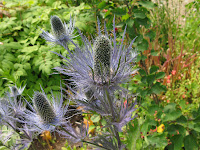
Sea Holly (Eryngium alpinum) Planted in 2007, bloomed in 2009. Over 2 feet tall, unique steely-blue brushlike flowers. Eryngium variifolium never grew more than a few inches tall and never flowered, so I got rid of it.
 Blue Fescue (Festuca glauca) Z3-small, non-spreading ornamental grass. Cut off the seed heads to prevent self-seeding.
Meadowsweet (Filipendula ulmaria/vulgaris) Z3 - wintered well. I eventually found it a bit boring and weedy-looking so I got rid of it.
Gentians (Gentiana sp.) - Very pretty little plants with the most intriguing deep blue flowers. Very sought-after.
--Gentiana verna - blooms here in May
 --Gentiana acaulis - large tubular flowers, blooms in June
 Cranesbills/Hardy geraniums (Geranium cinereum, G. macrorrhizum, G. pratense "Black Beauty") - G. cinereum does okay, G. macrorrhizum is robust but not as attractive
 Blue Oat Grass (Helictotrichon sempervirens) Z3- a mid-sized ornamental grass, non-spreading. After three years, the centers of mine rotted, but could be restored by dividing the grass and removing the rotten parts.
Daylily (Hemerocallis) Z3- do very well here. Almost all were killed in severe winter of 2009, but this is a rare occurence and I would still plant more.
 --Iris sibirica blue variety -->
 English Lavender (Lavendula angustifolia "Munstead") - made it through 3 winters now. Grows from new growth from the base of the plant each spring, so pruning off the dead old growth in spring keeps it tidy looking. Looks quite terrible here in spring (vs. mild climates where they stay green), so don't plant it at the front of a highly visible area. Mature plants killed off in severe winter of 2009, but seedlings remain.

Bitterroot (Lewisia cotyledon) - once of the most beautiful small perennials in existence, in my opinion. It flowers for us in June and does well in very well-drained soil. Insert pebbles around the base of the plant to keep its leaves off the soil. Quite hardy, though freakish cold winter of 2009 killed all plants. They did self-seed though, which is handy, as I find them a bit hard to start from seed indoors. Seeds seem to need the cold and changing temperature of the outdoors to germinate.
 Gayfeather (Liatris spicata) Z3 - a spiky purple wildflower that looks good in clusters, attracts butterflies. Most killed off in severe winter of 2009. They do self-seed a bit, so can leave a few offspring.
Perennial flax (Linum perenne) - delicate looking foliage with pale blue flowers on 10-12" tall plant.

Lupines (Lupinus) Z4 -
--Lupinus polyphyllus "Gallery Yellow"; very attractive flowers. This is the only lupine that continues to do well for me. Not a long-lived perennial here, and tends to die out randomly. Musk Mallow (Malva moschata) - pretty lavatera-like flowers, informal looking, bit gangly. Self-seeds moderately. Removed in 2008.
Ostrich Fern (Matteuccia) Z2- thrive here and multiply easily
Bergamot/Bee Balm (Mondarda didyma) Z3- a bit invasive but controllable, attracts butterflies. Center of old clump did not return in 2008, but had new growth at edges. Short-lived perennial.
--large clump of M. didyma, started from seed;
 Forget Me Not (Myosotis) - First planted in my yard in 2008, and now are reseeding around to make a gorgeous carpet of blue and pink in the spring. Biennial. Some killed in severe 2009 winter, but seedlings continued and will flower 2011.
Catmint (Nepeta cataria) - nice spray of blue flowers just as the tulips are ending, self-seeds alot! Spent 2008 removing it. Still removing seedlings in 2009.
Poppies (Papaver orientale/Oriental poppy, Papaver nudicaule/Iceland poppy, Papaver miyabeanum, Papaver somniferum, Papaver rhoeas) Z3 - grow very well; P. somniferum and rhoeas aren't perennial, but reseed themselves reliably.
Beardtongue (Penstemon ovatus) Z3 - grows well, self-seeds a bit
Peonies (Paeonia) - still waiting for any flowers! Need full sun and moist soil.
--Peony "Lotus Queen" (single flowered, white), planted 2005.
--Peony "Bouchela" (pink), planted 2007. Removed 2008 because of rust.
Creeping phlox (Phlox subulata) - one of the prettiest May/June flowers, short dense evergreen mat that is covered in flowers; comes in pink, pale blue, and white. Severe winter-kill in 2009, but still alive.
Jacob's Ladder (Polemonium caeruleum) Z2 - pretty blue or white spring flowers, informal 3 ft tall plants; self seeds moderately so will have to pull a bunch of them
Solomon’s Seal (Polygonatum) Z4 - I don't have this, but I think it grows here
Primroses (Primula denticulata Z4, P. auricula Z2, P. cortusoides Z2, Primula x polyanthus Z4) - the polyanthus is supposed to be the least hardy of these, but I've had them for 2 winters in my yard; auricula has waxy thick leaves and is extremely hardy and not killed by any winter we've ever had.
Lungwort (Pulmonaria saccharata "Mrs. Moon") Z4- very lovely plant with delicate blue spring flowers, part shade. Self-seeds a bit, which is a welcome source for new plants. Killed in severe winter of 2009.
 Pasqueflower (Pulsatilla vulgaris)- blooms at Easter, I have white, purple, red, and pink flowered plants. Very hardy. Self-seed a bit. Highly recommended.
 Rhubarb (Rheum) If you can't grow rhubarb, you can't grow anything! This plant is very hardy and stays attractive all season long. Of course, it's great for pies too. Attacked by slugs in 2009, but will survive.
 Rock Soapwort (Saponaria ocymoides) Z2- Flowered for one year then failed to bloom again. I wonder if it is hardy here. Bloomed nicely in 2009, but is rather unreliable.
Stonecrop (Sedum sp.) Z3-there are so many different kinds, we have a "wall" of the stuff as groundcover.
Hens and Chicks (Sempervivum tectorum)- there are many sizes and colors. These do well in some corner where not much else will grow.

Silene - various species grown by another local gardener. I started silene saxifraga from seed in 2008. It only flowers for about 2 days and then look unimpressive the rest of the summer.
Lamb's Ear (Stachys byzantina) - fuzzy grey plant, moderate creeper, keep its edges in check, attracts bees. Self-seeds if not deadheaded. Some killed in severe winter, but came back anyhow.
 Meadow Rue (Thalictrum sp) - I grow T. rochebrunianum and it does well, growing to about 7 feet tall and seeds itself around; elegant-looking plant with airy purple/pink cloud of tiny blooms at top. Looks neat growing among the tall delphiniums and at the back of the flower beds.

BULBS FOR THE NORTH [F] = Fall planting, [S] = spring planting
Ornamental Onions (Allium sp.) [F] - I am going to be experimenting with a few of the giant flowering types in 2008. "Purple sensation" came up the first year after planting, but not after that.
Glory of the Snow (Chionodoxa forbesii) [F] - tiny little early spring flowers; come in blue, white and pink; plant in clusters for effect
--Blue Chionodoxa
Crocuses (Crocus sp.) [F] - only the spring-blooming crocuses are hardy here.
--tiny snow crocuses, which come in several colors--> --large flowered crocuses -->

--Narcissus "Full House"
--Narcissus "Pacific Coast"
--Giant yellow trumpet daffodils-->

Fritillaries - [F] Fritillaria imperialis is NOT hardy here, but F. meleagris (Snake's head or checked lily) is hardy
--Fritillary meleagris (purple type) 2008-->

Snowdrops (Galanthus nivalis) [F] - Took 3 years to bloom! I have heard you need to plant them as a blooming plant (not a bulb) to have them thrive.
Dwarf iris (Iris reticulata "Harmony") [F] - I have plenty of these and love them! They are the first to bloom of all my flowers (in mid-April) in a very sunny sloped rock garden.
--Iris reticulata "Harmony"-->

Lilies (Oriental, Asiatic, LA Hybrids) [S] - do very well, I prefer the LA hybrids such as "Fangio" or, Oriental Pot Lily Farolito was very fragrant; summer flowering
--LA Hybrid Lily "Courier"-cream colored
--LA Hybrid Lily "Auckland"-white
--LA Hybrid Lily "Fangio"--> --LA Hybrid Lily "Yellow Tycoon", extremely long bloom time-->
 --Hybrid Asiatic "Cote d'Azur"-pink, multiplies rapidly
Virginia Bluebells (Mertensia virginia) [F] - grown by another local gardener
Grape Hyacinths (Muscari) [F] such a joyful spring flower, multiplies and naturalizes well
--Muscari latifolium (flat leaf muscari) - bloom is not as nice as the others
--Muscari armeniacum (blue)--> --Muscari botryoides "Album" (white)--> these multiply very slowly compared to the blue
 Siberian squill (Scilla siberica) [F] Z3 -spring flowering bulb, need a bunch of them to have any impact, small blue nodding flowers. Look more amazing every year.
--Scilla siberica --> Tulips, Botanical/Species [F] -These are naturalizing (return every year, spreading and multiplying) tulips that are tiny like crocuses, but come in bright colors and will outlive any of the larger showy tulips, which only last a few years. They either are wild-type or closely related to the wild-type tulips from Turkey.
--Tulipa tarda /Daystemon tarda--> --Tulipa turkestanica -->
  --Tulipa humulis/pulchella "Eastern Star"-->
 --Tulipa batalinii (in another La Ronge garden)-->
Tulips, Other [F] - I have had success with the large spectacular "Single Late", "Darwin Hybrid", and "Triumph" types; but I would never try ones labeled "Single Early/Double Early" in our climate, because the flowers could get deformed by late frosts. Gregii, Fosteriana, and Kaufmanii are probably good choices too, and they should return year after year.
--Double Late "Blue Diamond"-->
 --Triumph "Negrita" (purple) and "Zurel" (white and purple) - the first large tulips to bloom
--Darwin hybrid Yellow tulip-->


 Lily-flowered tulip "Tres Chic"-->

This is not a comprehensive list of hardy plants by any means, but possibly informative to new northerners!
My garden conditions: zone 1b, a short season, acidic soil (no one lives far from a bog), brutal winter temperatures, with lots of snow from November to March (the lake thaws in May).
A few of the plants are generally known as hardy, but I've never tried them. Local gardeners are encouraged to give feedback here! I included my own photos where available.Gardenista's List of PERENNIALS FOR THE NORTH
(Z=minimum hardiness zone rating)
Common yarrow (Achillea millefolium) - hardy but spreads quickly. I removed mine.
Monkshood (Aconitum napellus) – Very poisonous, Z4. I planted some in my yard in 2008. Still thriving in 2012. Very hardy and highly recommended. Blooms in late summer when other flowers are done.
 |
| Aconitum napellus |
Lady’s Mantle (Alchemilla mollis) Z4, a favourite, beautiful chartreuse foliage, water beads collect on the leaves like beads of mercury, forms a nice neat dome-shaped plant. Mature plants died in severe winter of 2009, but self-seeds minimally if dead-headed and will replace losses.
Windflower (Anemone sylvestris) Z4 - seeds itself and spreads everywhere, I avoid it --Aquilegia glandulosa (from another La Ronge garden) - a small blue-flowering plant-->
--Arabis caucasica (white). Very hardy. Blooms here in May. Short bloom time and looks drab the rest of the year.
 --Arabis blepharophylla (pink flowers) --died in winter of 2007. Not hardy.
 Sea Thrift (Armeria pseudarmeria) Z4-looks like a small chives plant in flower, does okay in the rock garden. Marginally hardy in severe winters, however. All dead by 2010.
Sage (Artemisia schmidtiana "Silvermound") Z4, flourishes, good dry-soil plant
Goatsbeard (Aruncus dioicus/sylvester) Z3, prefers moist soil, looks like a large astilbe with cream-colored feathery flowers that bloom for two weeks, I started mine from seed 2 years ago, they flowered in 2007. Several plants show signs of rust and were thrown out, but the rest were okay until the severe winter of 2009 killed them. Some seedlings appearing in 2012.
 |
| Artemisia "Silvermound" |
Goatsbeard (Aruncus dioicus/sylvester) Z3, prefers moist soil, looks like a large astilbe with cream-colored feathery flowers that bloom for two weeks, I started mine from seed 2 years ago, they flowered in 2007. Several plants show signs of rust and were thrown out, but the rest were okay until the severe winter of 2009 killed them. Some seedlings appearing in 2012.

Asters (A. alpinus, A. dumosus) very floriferous and very hardy; the Alpine aster is short with large purple flowers, with a short bloom time in June. My fall aster (A. dumosus) blooms in early October. Frequent division keeps these looking good.
--Aster alpinus "Goliath" -->
--Aster alpinus "Goliath" -->
Rockcress (Aubrieta deltoidea) Not particularly hardy here. Killed by most winters. Elephant Ears (Bergenia cordifolia) Z3 - excellent plant, evergreen, early flowering, highly recommended for sun or shade. Very hardy.Siberian Bugloss (Brunnera macrophylla) Z3 - very attractive foliage, hardy perennial for part to full shade. Looks good alongside hostas. Small blue flowers look like those of forget-me-nots. Killed by severe winter of 2009.
--Brunnera macrophylla "Jack Frost"
 Bellflowers (Campanula) Z3, very hardy bell-shaped flowers in blue, white, or purple. Highly recommended low-growing plants, flower in late June and July.
--Campanula carpatica "Blue Clips"-->
--Campanula carpatica "White Clips"--Campanula percisifolia alba (white type)
Snow in Summer (Cerastium tomentosum) Z3 - very hardy, spreads moderately so cut it down after blooming, gray foliage, carpet of white flowers. Cut it back at its margins in spring to reduce spread.
Chrysanthemum (Chrysanthemum morifolium, Morden series) While the grocery store mums are certainly not suited to the prairies (are not bred to flower in our conditions), the Morden mums are excellent.
 |
| Chrysanthemum morifolium "Morden Fiesta" |
Snakeroot (Actaea/Cimicifuga racemosa) Z3 - I have a nice deep reddish foliage specimen that does very well in my garden. A tall and attractive perennial that blooms later in the summer.
Clematis (Clematis macropetala, Clematis mandshurica)--Clematis mandshurica, white, very fragrant flowers, blooms in late summer;
 |
| Clematis mandschurica, a fragrant clematis that I grew from seed. |
 |
| Convallaria majalis "Rosea" |
Bunchberry (Cornus Canadensis) Z2 - grow wild everywhere here, no need to buy them!
Delphiniums (Delphinium species)- beautiful, reliably hardy. Self-seeds, so cut off dead flowers. May need to stake them to protect them in summer storms.
--D. grandiflorum "Blue Elf"
--D. elatum "Summer skies" (light blue)-->
--D. elatum "King Arthur" (deep purple)
--D. elatum "Blue Bird" (deep blue)
 |
| Delphinium elatum |
Pinks (Dianthus - nice little flowers, look good in the rock garden; killed off by severe winter of 2009, but seedlings will keep this plant going. Will plant again, as they survive all but the freakishly cold winters. Highly recommended for mid to late summer blooms.
 |
| Dianthus deltoides "Arctic Fire" |
 |
| Dianthus gratianopolitanus "Firewitch" |
 |
| Dicentra spectabilis "Alba" |

Foxglove (Digitalis) - Lovely spires of flowers in pink, white, violet, yellow and apricot shades. All spread seeds generously if the seedheads are not removed. Only grandiflora is perennial, white the others are biennial (so you want to let them spread their seeds). Digitalis mertonensis (the strawberry foxglove) is also very nice.
 |
| Digitalis grandiflora |
 |
| Digitalis purpurea |
Shooting Star (Dodecatheon pulchellum) -- from another La Ronge garden. Blooms in June.

Purple Coneflower (Echinacea purpurea) Z2 - very pretty, hardy tall pink flower. Mature plants killed off in severe winter of 2009. Flowers in second year and thereafter. Most kinds can be grown from seed.
 |
| Wild-type Echinacea |
 |
| Echinacea purpurea "Ruby Star". |
Sea Holly (Eryngium alpinum) Planted in 2007, bloomed in 2009. Over 2 feet tall, unique steely-blue brushlike flowers. Eryngium variifolium never grew more than a few inches tall and never flowered, so I got rid of it.

Meadowsweet (Filipendula ulmaria/vulgaris) Z3 - wintered well. I eventually found it a bit boring and weedy-looking so I got rid of it.
Gentians (Gentiana sp.) - Very pretty little plants with the most intriguing deep blue flowers. Very sought-after.
--Gentiana verna - blooms here in May
 --Gentiana acaulis - large tubular flowers, blooms in June
 Blue Oat Grass (Helictotrichon sempervirens) Z3- a mid-sized ornamental grass, non-spreading. After three years, the centers of mine rotted, but could be restored by dividing the grass and removing the rotten parts.
Daylily (Hemerocallis) Z3- do very well here. Almost all were killed in severe winter of 2009, but this is a rare occurence and I would still plant more.
 |
| Daylily |
Coralbells (Heuchera sanguinea splendens) Z3- suprisingly do well here, I have several different kinds with a variety of foliage colors including "Palace purple", "Velvet night", and "Firefly"; must have good snow cover. All killed off by the severe winter of 2009.
Plantain Lily (Hosta sp. ) Z3- several including H. sieboldiana "Elegans" they don't pop out of the ground till late May, but look nice when they do. Good for part shade. All killed off by the severe winter of 2009, but I replaced them, as they usually are quite hardy.
Plantain Lily (Hosta sp. ) Z3- several including H. sieboldiana "Elegans" they don't pop out of the ground till late May, but look nice when they do. Good for part shade. All killed off by the severe winter of 2009, but I replaced them, as they usually are quite hardy.
 |
| Hosta "Frances William" |
Siberian Iris (Iris sibirica) - I have 2 varieties that do well in my yard, full sun and moderate moisture. Very winter hardy.
--Iris sibirica "Snow Queen" -->
--Iris sibirica blue variety -->English Lavender (Lavendula angustifolia "Munstead") - made it through 3 winters now. Grows from new growth from the base of the plant each spring, so pruning off the dead old growth in spring keeps it tidy looking. Looks quite terrible here in spring (vs. mild climates where they stay green), so don't plant it at the front of a highly visible area. Mature plants killed off in severe winter of 2009, but seedlings remain.
Bitterroot (Lewisia cotyledon) - once of the most beautiful small perennials in existence, in my opinion. It flowers for us in June and does well in very well-drained soil. Insert pebbles around the base of the plant to keep its leaves off the soil. Quite hardy, though freakish cold winter of 2009 killed all plants. They did self-seed though, which is handy, as I find them a bit hard to start from seed indoors. Seeds seem to need the cold and changing temperature of the outdoors to germinate.
 Gayfeather (Liatris spicata) Z3 - a spiky purple wildflower that looks good in clusters, attracts butterflies. Most killed off in severe winter of 2009. They do self-seed a bit, so can leave a few offspring.
Perennial flax (Linum perenne) - delicate looking foliage with pale blue flowers on 10-12" tall plant.

Lupines (Lupinus) Z4 -
--Lupinus polyphyllus "Gallery Yellow"; very attractive flowers. This is the only lupine that continues to do well for me. Not a long-lived perennial here, and tends to die out randomly.
Musk Mallow (Malva moschata) - pretty lavatera-like flowers, informal looking, bit gangly. Self-seeds moderately. Removed in 2008.Ostrich Fern (Matteuccia) Z2- thrive here and multiply easily
Bergamot/Bee Balm (Mondarda didyma) Z3- a bit invasive but controllable, attracts butterflies. Center of old clump did not return in 2008, but had new growth at edges. Short-lived perennial.
--large clump of M. didyma, started from seed;
Forget Me Not (Myosotis) - First planted in my yard in 2008, and now are reseeding around to make a gorgeous carpet of blue and pink in the spring. Biennial. Some killed in severe 2009 winter, but seedlings continued and will flower 2011. |
| Myosotis sylvatica "Victoria pink" |
Poppies (Papaver orientale/Oriental poppy, Papaver nudicaule/Iceland poppy, Papaver miyabeanum, Papaver somniferum, Papaver rhoeas) Z3 - grow very well; P. somniferum and rhoeas aren't perennial, but reseed themselves reliably.
Beardtongue (Penstemon ovatus) Z3 - grows well, self-seeds a bit
Peonies (Paeonia) - still waiting for any flowers! Need full sun and moist soil.
--Peony "Lotus Queen" (single flowered, white), planted 2005.
--Peony "Bouchela" (pink), planted 2007. Removed 2008 because of rust.
Creeping phlox (Phlox subulata) - one of the prettiest May/June flowers, short dense evergreen mat that is covered in flowers; comes in pink, pale blue, and white. Severe winter-kill in 2009, but still alive.
 |
| Phlox subulata |
Solomon’s Seal (Polygonatum) Z4 - I don't have this, but I think it grows here
Primroses (Primula denticulata Z4, P. auricula Z2, P. cortusoides Z2, Primula x polyanthus Z4) - the polyanthus is supposed to be the least hardy of these, but I've had them for 2 winters in my yard; auricula has waxy thick leaves and is extremely hardy and not killed by any winter we've ever had.
 |
| Polyanthus |
 | |
| Primula saxatilis |
 |
| Primula auricula |
Pasqueflower (Pulsatilla vulgaris)- blooms at Easter, I have white, purple, red, and pink flowered plants. Very hardy. Self-seed a bit. Highly recommended.Rhubarb (Rheum) If you can't grow rhubarb, you can't grow anything! This plant is very hardy and stays attractive all season long. Of course, it's great for pies too. Attacked by slugs in 2009, but will survive. Rock Soapwort (Saponaria ocymoides) Z2- Flowered for one year then failed to bloom again. I wonder if it is hardy here. Bloomed nicely in 2009, but is rather unreliable.
Stonecrop (Sedum sp.) Z3-there are so many different kinds, we have a "wall" of the stuff as groundcover.
Hens and Chicks (Sempervivum tectorum)- there are many sizes and colors. These do well in some corner where not much else will grow.

 |
| Sempervivum in bloom |
Lamb's Ear (Stachys byzantina) - fuzzy grey plant, moderate creeper, keep its edges in check, attracts bees. Self-seeds if not deadheaded. Some killed in severe winter, but came back anyhow.
Meadow Rue (Thalictrum sp) - I grow T. rochebrunianum and it does well, growing to about 7 feet tall and seeds itself around; elegant-looking plant with airy purple/pink cloud of tiny blooms at top. Looks neat growing among the tall delphiniums and at the back of the flower beds.
BULBS FOR THE NORTH [F] = Fall planting, [S] = spring planting
Ornamental Onions (Allium sp.) [F] - I am going to be experimenting with a few of the giant flowering types in 2008. "Purple sensation" came up the first year after planting, but not after that.
Glory of the Snow (Chionodoxa forbesii) [F] - tiny little early spring flowers; come in blue, white and pink; plant in clusters for effect
--Blue Chionodoxa

Crocuses (Crocus sp.) [F] - only the spring-blooming crocuses are hardy here.
--tiny snow crocuses, which come in several colors-->
--large flowered crocuses -->
Daffodils and Narcissus - [F] Did not come up in quite shady areas. Random plantings did not come up at all even in sunny places, but several are doing fantastic in the raised bed with some late afternoon shade. Daffodils are a better value than tulips, since they will naturalize while tulips have to be replanted.
--Narcissus Poetaz "Geranium"--Narcissus "Full House"
--Narcissus "Pacific Coast"
--Giant yellow trumpet daffodils-->

Fritillaries - [F] Fritillaria imperialis is NOT hardy here, but F. meleagris (Snake's head or checked lily) is hardy
--Fritillary meleagris (purple type) 2008-->

Snowdrops (Galanthus nivalis) [F] - Took 3 years to bloom! I have heard you need to plant them as a blooming plant (not a bulb) to have them thrive.
Dwarf iris (Iris reticulata "Harmony") [F] - I have plenty of these and love them! They are the first to bloom of all my flowers (in mid-April) in a very sunny sloped rock garden.
--Iris reticulata "Harmony"-->
Lilies (Oriental, Asiatic, LA Hybrids) [S] - do very well, I prefer the LA hybrids such as "Fangio" or, Oriental Pot Lily Farolito was very fragrant; summer flowering
--LA Hybrid Lily "Courier"-cream colored
--LA Hybrid Lily "Auckland"-white
--LA Hybrid Lily "Fangio"-->
--LA Hybrid Lily "Yellow Tycoon", extremely long bloom time-->--Hybrid Asiatic "Cote d'Azur"-pink, multiplies rapidlyVirginia Bluebells (Mertensia virginia) [F] - grown by another local gardener
Grape Hyacinths (Muscari) [F] such a joyful spring flower, multiplies and naturalizes well
--Muscari latifolium (flat leaf muscari) - bloom is not as nice as the others
--Muscari armeniacum (blue)-->
--Muscari botryoides "Album" (white)--> these multiply very slowly compared to the blueSiberian squill (Scilla siberica) [F] Z3 -spring flowering bulb, need a bunch of them to have any impact, small blue nodding flowers. Look more amazing every year.--Scilla siberica -->
Tulips, Botanical/Species [F] -These are naturalizing (return every year, spreading and multiplying) tulips that are tiny like crocuses, but come in bright colors and will outlive any of the larger showy tulips, which only last a few years. They either are wild-type or closely related to the wild-type tulips from Turkey.--Tulipa tarda /Daystemon tarda-->
--Tulipa turkestanica --> --Tulipa humulis/pulchella "Eastern Star"-->--Tulipa batalinii (in another La Ronge garden)-->Tulips, Other [F] - I have had success with the large spectacular "Single Late", "Darwin Hybrid", and "Triumph" types; but I would never try ones labeled "Single Early/Double Early" in our climate, because the flowers could get deformed by late frosts. Gregii, Fosteriana, and Kaufmanii are probably good choices too, and they should return year after year.
--Double Late "Blue Diamond"-->
 --Triumph "Negrita" (purple) and "Zurel" (white and purple) - the first large tulips to bloom
--Darwin hybrid Yellow tulip-->

--Single Late "Menton" - initially peach colored, then turn pink -->

--Single Late "Maureen" (white)
--Single Late "Skagit Valley"-->

--Single late "Florissa" (dark pink)-->
Lily-flowered tulip "Tres Chic"-->
This is not a comprehensive list of hardy plants by any means, but possibly informative to new northerners!
Subscribe to:
Posts (Atom)